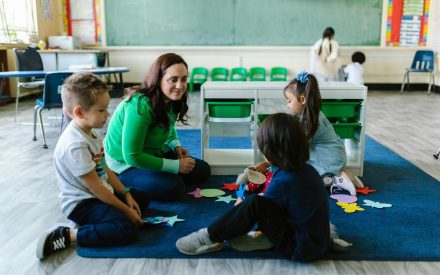
One important part of learning about money is me, or yourself. When we talk about ‘me’, there are four main things to think about:
- Self-control: Sometimes we can’t have what we want right away and need to wait. Choosing not to spend money can sometimes be a good decision.
- Follow-through: Sticking with a plan to reach a goal can be hard. It takes effort, skill, and sometimes help from others.
- Staying true to yourself: Sometimes we might feel left out if we don’t have what other people have. Knowing what’s important to you and not comparing yourself to others can help you feel good about your decisions.
- Flexibility: It’s important to learn from mistakes. We can change our plans and try something new if our first idea isn’t working.
How Children Show…
- Self-control: Children can talk about times when they were able to wait to do or buy something and how they were able to do it.
- Follow-through: Children can identify who they can turn to for help reaching a goal, or what tools or tricks might help them stick with a plan.
- Staying true to yourself: Children can name one special thing they like about themselves and one thing that makes each family member special too. Ages 7+: Can discuss why it’s okay that different people use their money for different things.
- Flexibility: Children can talk about a time when their plans didn’t turn out how they wanted and what they did instead.
Recommended Children’s Books
Below are just a few of the children’s books that have a financial lesson. Some libraries may even have a parent guide that will be given to you when you check out the book.
Self-control: Curious George Saves His Pennies, But I’ve Used all of My Pocket Change
Follow-through: Jenny Found a Penny, Just Saving My Money, Tops and Bottoms, Ella Earns Her Own Money
Staying true to yourself: Those Shoes, You Can’t Buy a Dinosaur with a Dime, How Much is That Doggie in the Window
Flexibility: Lemonade in Winter, Follow the Money, Count on Pablo
Fun Money Activities
Having discussions and doing activities together is a great way to learn about each of the key ideas when
learning about financial concepts. Below are some ideas you can use to teach your child about each concept:
Staying true to yourself
(Ages 3+) What are your child’s favorite games and toys? The next time you play together, ask your child what they like best about that activity. Talk about skills that your child uses during that game: ‘You always pick such fun colors for your pictures.’
(Ages 5+) Talk about other favorites that you and your child have – food, books, colors, etc. What favorites do you share? What’s different? What would the world be like if everyone liked the same things?
(Ages 7+) Young children often don’t understand the difference between TV shows and commercials. When a commercial comes on, talk about what it is selling. Is this something they would like? What would they be willing to give up or trade for that item?
Flexibility
You can use changes in the weather to talk about being flexible. Talk about what activities you and your child have planned for the day. How would this change if the weather was different – a lot colder or hotter, rainy or snowy, etc.? If the weather was the opposite of what you had planned, how could you change your plans? It’s okay to be sad when plans change. Sometimes it might even be more fun!
Self-control
The next time you’re at the store with your child, talk about items you ‘wish’ you could buy, but choose to pass up. Talk about what you will do with the money you choose not to spend. For example, “If I don’t buy this and keep my dollar, I
could save my dollar, wait until I have more, and buy_______ instead.”
Follow-through
- (Ages 3+) Having a daily routine is like having a plan to follow. As you go through your day, talk with your child about what activity comes next: “After you brush your teeth, then what do we do?” Talk about why it’s still a good idea to do something, even if we may not always feel like doing it.
- (Ages 6+) Do an activity with your child that lets you follow directions together. Maybe it’s following a recipe for cooking or following instructions for putting together a puzzle. Read each step out loud and talk about the best way to follow that step. Enjoy the effort and celebrate your success.
To $um it up
- Preschoolers can learn skills that will help them handle their money well as adults.
- Family activities can spark talks about earning, saving, and planning.
- Reading books with stories about money is a fun way to talk about spending and goals.
- Talk about spending decisions at the store to make the most of those everyday money moments.
Want to Learn More:
- Visit our website for more financial education resources. https://finances.extension.wisc.edu
- Contact your local Extension Educator: https://counties.extension.wisc.edu
- For help with balancing your monthly spending plan, contact the nonprofit National Foundation for Credit Counseling (NFCC) at https://www.nfcc.org or 800.388.2227.
Authored by Katie Gellings, Human Development & Relationships Educator, Outagamie County. The University of Wisconsin–Madison Division of Extension provides equal opportunities in employment and programming in compliance with state and federal law. You may request materials in an alternative language and/or format to make them more accessible. Contact us at finances@extension.wisc.edu. Services are provided at no cost to you.